Best executive search firms for critical leadership hires

Content authorBy Michelle BohannonPublished onReading time14 min read
A modern boardroom scene with a large ivory table, board members evaluating executive search firms, illuminated by natural light.

This article compares seven of the best executive search firms across different leadership needs, from large public-company succession work to founder transitions and growth-stage hiring. It also explains how to evaluate a search partner based on the outcomes a critical hire needs to achieve, the expertise required to deliver them, and the assessment process used before you sign a retainer.

Why mandate fit matters

Choosing among the best executive search firms on brand strength alone can produce an impressive shortlist without proving that the firm has solved the leadership problem your company actually faces. Scale matters, but so does whether the lead partner has recruited leaders in a comparable company, market, and stage of growth.

The decision should start with the outcomes the new leader needs to achieve. For a growth- or commercial-stage MedTech company, that could mean building a commercial organization, accelerating adoption, entering a new market, or preparing the business for its next stage of scale. Sound executive search firm evaluation criteria start with those outcomes, while executive search firm industry expertise matters when it helps identify candidates with the experience and competencies required to deliver them.

Best executive search firms to consider

The firms below represent different models, from large global platforms to more specialized search organizations. Rather than treating the list as a universal ranking, compare each firm's capabilities, focus, and operating model against the specific leadership outcomes your company needs.

1. Spencer Stuart

Spencer Stuart works at the top of the public company market, and its own data shows how tight that market has become. S&P 500 boards appointed 374 new independent directors in 2025, an 8% decline and the lowest count since 2016, with only half of boards adding anyone at all. When refreshment slows, access to sitting and recently retired chief executives matters more than process.

That's where the firm earns its place among the best executive search firms for high-stakes appointments. Its consultants operate across more than 60 offices in over 30 countries, which matters when a CEO succession involves multiple regulators or an investor base spread across three continents. The firm's research also shows where boards are falling short, with only 43% of CEOs saying their directors have expertise aligned to the company's most pressing issues, compared with 63% of directors who think they do.

For companies evaluating Spencer Stuart, two practical considerations are off-limits restrictions and engagement structure. Its extensive client base can affect which executives are accessible, so companies should clarify the available candidate pool and the level of senior partner involvement before starting a search.

2. Russell Reynolds Associates

Russell Reynolds has significant experience in board composition, CEO succession, and leadership assessment. Its Global CEO Turnover Index recorded 202 CEO departures in 2024 across 13 major indices, the highest on record. Of those, 43 leaders lasted under 36 months. Tracking data at that level of detail informs how the firm approaches composition and succession work.

Margot McShane, co-lead of the firm's global board and CEO practice, told Reuters that companies increasingly ask for executives who can execute a change agenda but "It is only getting harder to be a CEO, where you're navigating uncharted territory." That framing runs through the firm's assessment-led approach, which pairs board effectiveness reviews with director search rather than treating them as separate purchases. Its executive search firm industry expertise includes significant work across financial services and large-cap technology.

Companies should also consider whether an assessment-heavy engagement matches the scope and timing of the search. A more consultative process can add value when leadership assessment and succession planning are part of the mandate, but may be more extensive than necessary for a narrowly defined search.

3. Heidrick and Struggles

Heidrick suits boards that want director recruitment connected to something larger. The firm runs a separate consulting arm that booked $94 million in 2024 revenue alongside 418 executive search consultants, so culture work and search sit under one roof.

That structure pays off when a new CEO arrives and the board realizes the enterprise culture will not carry the strategy. It also helps when the same team is mapping both the director market and the internal succession bench. Average revenue per executive search reached $146,000 in 2024, up from $140,000, which tells you the firm is working further upmarket.

Because Heidrick operates across executive search and consulting, companies should define the scope of the engagement clearly from the start. That includes specifying which search, assessment, and consulting services are part of the mandate and which are not.

4. Egon Zehnder

Egon Zehnder is built for the long conversation. The firm runs as a single profit center with an all-partner model and no associate layer beneath the consultant who takes your brief, and it reports more than 3,600 board-consulting assignments over five years. Growth has been organic rather than acquisitive, which keeps the compensation model intact.

That design fits succession planning that starts three years before the transition, where the work is assessing internal candidates honestly and telling a chair something they don't want to hear. Spencer Stuart's European analysis found that 84% of 2024 appointments went to first-time listed company CEOs, which raises the stakes on internal readiness work.

For time-sensitive appointments, companies should confirm whether the firm's consultative model fits the required timeline. Its approach may be particularly relevant when succession planning and leadership assessment extend beyond an immediate placement.

Bring your next commercialization hire through the system.

If you’re filling a commercial leadership role inside a growth-stage MedTech environment, the strategy call is where we map the role to CarbonCore.

Schedule a Strategy Call →

5. Korn Ferry

Korn Ferry sells assessment and benchmarking at industrial scale. Its consulting segment reported $662.7 million in fiscal 2025 fee revenue with 1,599 consulting and execution staff, on top of North American executive search revenue of $535.9 million. Few competitors operate with the same scale of comparative compensation and competency data behind their recommendations.

Korn Ferry may be relevant when the vacancy is only one part of a broader talent or organizational challenge. Its assessment and benchmarking capabilities can support companies building a multi-year leadership bench or comparing compensation and readiness across roles. Assessment data informs judgment about fit and readiness, but should not be treated as a guarantee of how someone will perform in the role.

The consideration is scope. Korn Ferry operates across a broad set of organizational consulting and talent services, with director search representing one part of a much larger platform. Companies should confirm that the engagement model and senior-team involvement match the needs of the specific search.

6. RSR Partners

RSR Partners was founded in Greenwich, Connecticut in 1993 by Russell S. Reynolds, Jr., who had founded Russell Reynolds Associates in 1969 and sold his interest before starting again. The second firm was deliberately small. Carter Burgess, who heads its board recruiting practice, writes that senior members "lead and execute every engagement and handle all candidate interface, assessments, references, and client interaction."

For a nominating committee that wants the person who pitched to be the person who calls candidates, that's the whole argument. The practice specializes in director searches and full board build-outs across public and family-owned companies.

RSR's platform is more concentrated in the United States than those of the largest global firms. For mandates requiring extensive candidate sourcing across multiple international markets, companies should evaluate whether that geographic footprint matches the search.

7. True Search

True built its network in the venture and growth ecosystem before moving upmarket. It has closed more than 6,800 venture capital searches since 2019 and reports connections to over 675,000 CEO and board-level executives through its board practice. Among the best executive search firms covered here, its background makes it particularly relevant to founder transition and growth-stage environments.

Its venture and growth-stage background makes the firm particularly relevant to founder transitions and Series C through pre-IPO environments. The firm's own numbers show 72% of board clients return to fill multiple leadership roles, which suggests clients often extend the relationship beyond the first search.

Its experience is rooted more heavily in venture, growth, and technology-oriented environments than in decades of large-cap public-company governance work. Companies facing highly specialized public-company governance situations should evaluate that experience against the requirements of the mandate.

Comparing best executive search firms

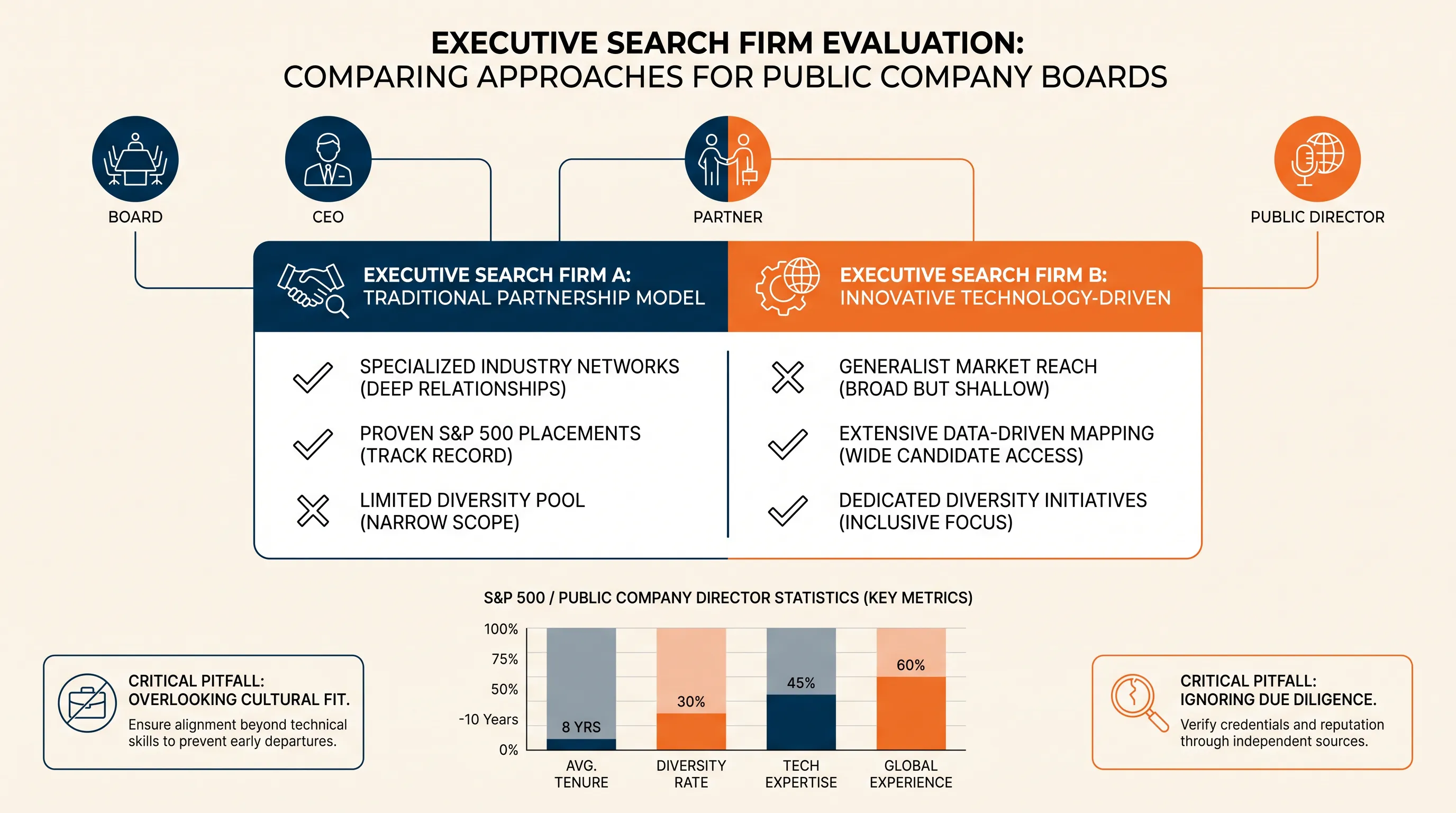
Flat infographic comparing two executive search firm profiles with icons, checklists, and a bar chart on a warm off-white background.

The best executive search firms often cover overlapping leadership categories, so service labels alone reveal little about fit. The comparison should happen at the level of the specific mandate, company stage, industry, and partner who would run the search.

For growth- and commercial-stage MedTech companies, that means going beyond titles and defining what the hire must actually accomplish. A commercial leader hired to build a sales organization, accelerate adoption, or prepare for the next stage of growth requires a different profile from an executive recruited for a mature public company.

Bring your next commercialization hire through the system.

If you’re filling a commercial leadership role inside a growth-stage MedTech environment, the strategy call is where we map the role to CarbonCore.

Schedule a Strategy Call →

Executive search firm evaluation criteria

Evaluate each candidate firm against the same criteria, in writing, before the pitch meetings start:

  • Board composition assessment: does the firm produce a skills matrix tied to your strategy, or a generic template?

  • CEO succession support: can it run emergency and long-horizon planning, given that 30% of public company directors report no identified successor?

  • Director market mapping: how many named candidates in your target profile, and how recently were they contacted?

  • Role definition and assessment: does the firm define the outcomes the hire needs to achieve and translate them into competencies, interview questions, and consistent evaluation criteria before sourcing begins?

  • Stage and commercialization fit: has the firm recruited leaders for companies at a comparable stage of growth and commercialization?

  • Commercial leadership evidence: can the firm show comparable searches involving market expansion, adoption, revenue growth, or commercial team scaling?

  • Transformation evidence: comparable placements where the board faced the same pressure, with outcomes you can verify.

  • Global reach against actual need.

  • Named partner involvement through candidate interviews, references, and the offer.

  • References from clients with comparable leadership mandates.

For TruAlign, this outcome-first approach is central to the search process. The work begins by defining what the leader needs to accomplish, then translating those outcomes into role requirements, competencies, interview questions, scorecards, and behavioral benchmarks. The McQuaig Job Survey provides an additional behavioral benchmark, while CarbonCore brings assessment findings, interview feedback, candidate responses, and supporting documentation into one structured decision environment.

This is especially important in MedTech commercial leadership searches, where two candidates may have similar titles but very different experience building teams, navigating complex buying environments, driving adoption, or scaling revenue.

Weight those executive search firm evaluation criteria differently for each mandate. A family-owned business planning a generational handover will prioritize different capabilities from a growth-stage MedTech company hiring a commercial leader or a public company facing activist pressure. Applying uniform executive search firm evaluation criteria across unlike mandates can produce a technically qualified firm that is not well matched to the actual leadership challenge.

Industry expertise and access

Executive search firm industry expertise should show up in relevant search experience. Ask the partner to describe recent leadership placements in your sector, what each executive was hired to accomplish, and how the candidate profile was built around those outcomes. If the answer stays at the level of "we have deep healthcare coverage," ask who will actually lead the engagement and what comparable searches that person has completed.

The demand signal here is specific. Close to half of S&P 500 companies now mention AI in director qualifications, up from 26% in 2024, and 86% disclose cybersecurity as expertise a director has or the board is seeking. Genuine executive search firm industry expertise means the partner can distinguish between candidates who have actually delivered the required outcomes and those whose titles or resumes only appear to match the mandate.

Then there's the constraint nobody volunteers. The AESC Client Bill of Rights states that the written engagement agreement should cover off-limits, conflicts, and data management terms from the start. Require a written list of restricted companies mapped against your priority targets before you sign, because executive search firm industry expertise has limited value if the firm's client roster blocks the companies where your strongest potential candidates are currently working.

Match firm capabilities to the mandate

The seven best executive search firms above bring different capabilities, operating models, and areas of experience. The examples below show where those characteristics may be relevant, rather than prescribing one firm as the universal choice for a particular mandate:

  1. Routine director refreshment at a mid-cap: RSR Partners and True Search are examples of firms with more focused operating models that may appeal to companies seeking direct senior-team involvement.

  2. Activist pressure: firms such as Spencer Stuart and Russell Reynolds bring experience in large public-company environments. Activists won 119 board seats in 2024 and drove a record 27 CEO resignations, making experience with governance and stakeholder dynamics an important evaluation factor.

  3. AI and cybersecurity oversight: Heidrick and True are examples of firms with experience relevant to technology-driven leadership requirements, while 62% of directors now reserve full-board agenda time for AI, up from 28% in 2023.

  4. Founder transition: True Search's roots in venture and growth-stage companies make its experience relevant to this setting.

  5. CEO succession with internal candidates: Egon Zehnder and Korn Ferry both offer assessment capabilities that companies may consider when evaluating internal and external candidates.

  6. Enterprise culture change alongside recruitment: Heidrick combines executive search with consulting capabilities, which may be relevant when leadership recruitment is part of a broader organizational change initiative.

Boutique and global firms offer different advantages. Smaller search firms may provide more direct senior-level involvement, while global platforms can offer broader geographic reach and infrastructure. Run your executive search firm evaluation criteria against the actual mandate, company stage, industry, and outcomes required rather than relying on firm size or brand recognition alone.

Validate before appointment

Before the engagement letter is signed, put these questions to the partner directly and keep the answers. Which named partner conducts candidate interviews and reference calls, and what is their committed time allocation? What are the two closest comparable mandates in the last 36 months, and will those clients take a reference call? How large is the accessible pool after off-limits restrictions, expressed as a number?

Ask how the firm defines what success in the role requires before the search begins, and how those outcomes are translated into competencies, interview questions, and scorecards. TruAlign applies this outcome-first approach before candidate evaluation begins, while the McQuaig Job Survey provides an additional behavioral benchmark for the role. CarbonCore then brings candidate information, assessment findings, interview feedback, and supporting documentation into one structured decision environment. Behavioral assessment should sit alongside experience, structured interviews, references, and professional judgment rather than replace them. Ask for the timeline with named milestones and what happens if the slate stalls at week ten. Then check the firm's standing against the AESC Code of Professional Conduct, which commits members to a candid assessment of their capabilities and to declining work they are not qualified for.

Reference checks are where the best executive search firms separate from the well-marketed ones. Speak to a client who completed a comparable leadership search under conditions close to yours, and ask what the firm got wrong. Evidence of executive search firm industry expertise that survives that conversation is worth more than any credentials deck, and the same goes for every other item in your executive search firm evaluation criteria.

Conclusion

Critical leadership searches succeed or fail on fit. Define what the new leader needs to accomplish, the company stage and market conditions they will operate in, and the competencies required to deliver those outcomes. Then evaluate search firms against those requirements rather than choosing on brand recognition alone.

TruAlign Partners helps growth-stage and commercial-stage MedTech companies define what a critical commercial hire needs to accomplish before the search begins. Those outcomes inform the role requirements, competencies, interview questions, scorecards, and behavioral benchmarks used throughout the search. The McQuaig Job Survey provides an additional behavioral benchmark, while CarbonCore brings candidate assessments, interview feedback, responses, and supporting documentation into one structured decision environment. If you are preparing for your next commercial leadership hire, schedule a conversation with our team.


Bring your next commercialization hire through the system.

If you’re filling a commercial leadership role inside a growth-stage MedTech environment, the strategy call is where we map the role to CarbonCore.

Schedule a Strategy Call →

The agreement should define the fee structure, replacement terms, confidentiality duties, data handling, off-limits restrictions, and termination rights. Ask for milestones, partner responsibilities, and approval points in writing. These details help a board compare the best executive search firms on service terms, not presentation quality.

Off-limits restrictions prevent a search firm from approaching employees of selected client companies for a stated period. Request the restricted-company list before signing, then compare it with your target employers. A large network can produce a smaller usable candidate pool when those restrictions cover the people you need.

Yes, if its partners have handled comparable public company situations and can provide chair references. Test experience with governance disputes, investor scrutiny, regulatory requirements, and cross-border sourcing. A boutique can suit a focused mandate, but a global search is a poor fit if the firm lacks the required geographic reach.

Ask former chairs whether the named partner stayed involved, produced candidates who matched the agreed profile, explained weak options, and handled setbacks honestly. Ask what the firm got wrong and what happened after the placement. Use references from mandates with similar ownership, urgency, and board pressure.

A commercial-stage MedTech or life sciences company should contact TruAlign Partners when it needs to define the role and board mandate before sourcing begins. A call can clarify the leadership problem, required experience, and search scope. That discussion can also help the client decide whether an external search firm is appropriate.

Schedule a Strategy Call

Map the role to CarbonCore and confirm fit before search work begins.

Schedule a Strategy Call