Verify past judgment
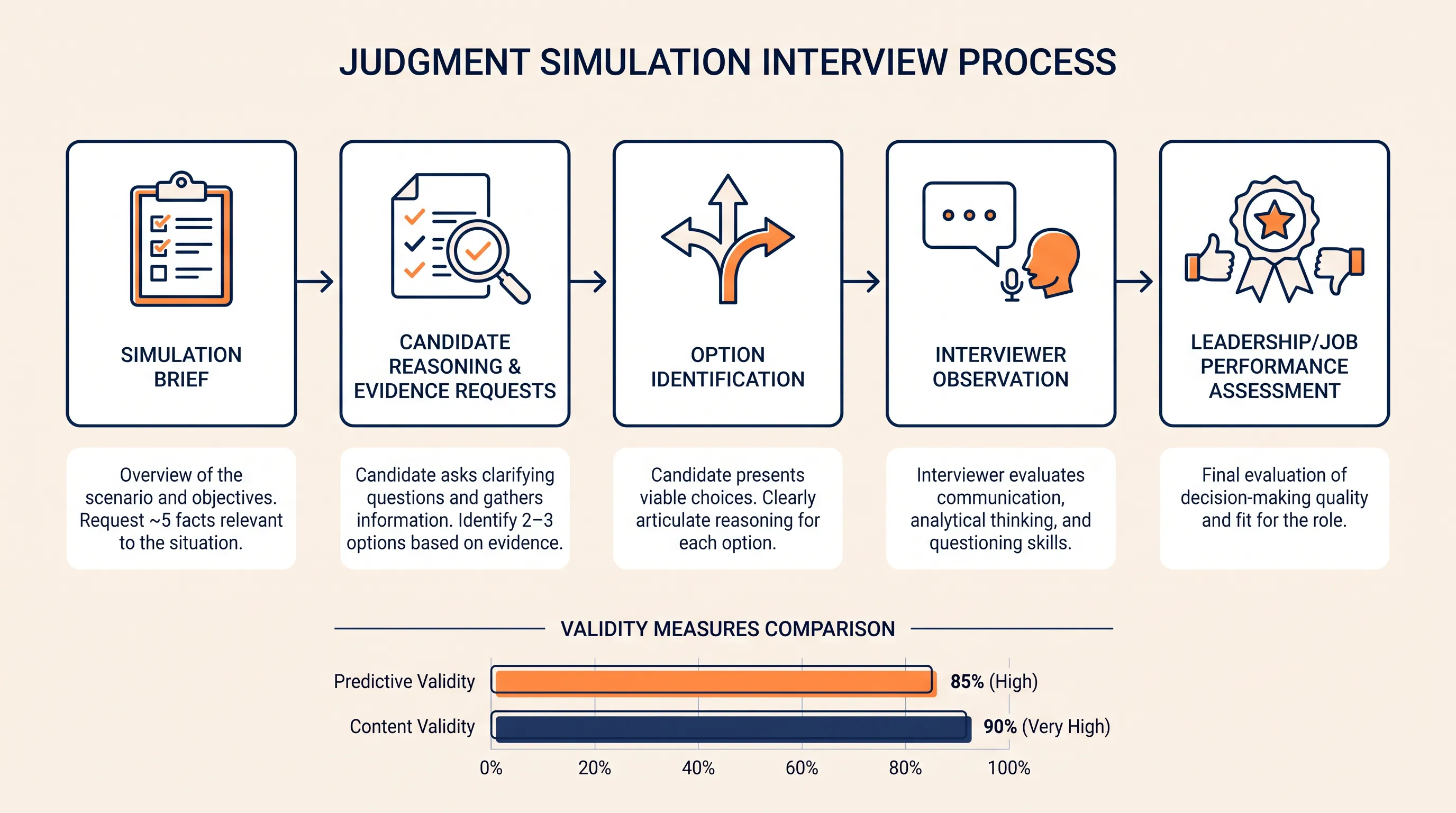
A simulation shows how someone reasons in a room with you without showing what they did when the decision was real and the consequences landed on their own team. That's why the simulation is one leg of the evidence and not the whole thing, and why a serious recruiting and hiring process triangulates it against a documented past decision and the people who watched it happen.
Use a structured interview
Pick one comparable decision from the candidate's history and go deep on it for 45 minutes. What was the situation, in specifics? What did you personally decide, as distinct from what the team decided? What options did you reject, and why? What happened, and what did you do when your assumptions turned out to be wrong?
Frame it plainly at the start: this is an evidence check on one decision. Candidates respond well to the clarity, and the structured interview format keeps you from drifting into the pleasant conversation that produces nothing comparable. Swider and colleagues found across 163 mock interviews that impressions formed during pre-interview rapport building influence ratings of answers to structured questions, more strongly early in the session than late. Front-load the script.
Check varied references
Talk to a former supervisor and a peer who had no reporting relationship. Add someone who worked for the candidate. Ask all of them the same questions, in the same order:
-
Describe a hard call this person made that you observed directly. What did they weigh?
-
How did they handle the stakeholder who lost that argument?
-
When something they decided didn't work, what did they do next?
-
What did they own publicly, and what did they attribute elsewhere?
Reference checks have a weak reputation, and the older validity research earned it. Schmidt and Oh noted that employers remain reluctant to provide more than dates and job titles. But the low estimates came from unstructured calls. Taylor and colleagues found that a structured telephone reference procedure held up better than the reputation suggests. What you're hunting is repetition across three independent sources. Reference work is also where the time to hire formula stretches, so book the calls the same week you run the simulations.
Avoid misleading signals
The most common failure is rewarding presentation. Ram Charan, who has advised boards on CEO succession for four decades, put it bluntly: a board that meets candidates only in the boardroom is judging presentation, not leadership. Fluency is a real skill for a commercial executive. It is not the same skill as deciding well, and the exercise exists to separate them.
Watch for two other traps. Interviewers ask questions that confirm their first impressions and they sell the job once they've warmed to someone, which is exactly why the structured interview script and the independent scorecards matter. And keep the scenario hypothetical. In a survey of roughly 700 candidates, interviewing.io found that 58% believed they deserved compensation for take-home work while only 4% ever received it. Speed is a legitimate constraint, and the time to hire formula is the right way to track it. Just don't let a fast recruiting and hiring process become an excuse for the version where everyone nods at the polished finalist and calls it consensus.
Coordinate evidence with TruAlign
TruAlign Partners starts before the candidate slate is built. For commercial-stage MedTech searches, we first define what the person in the role needs to accomplish, then use our CarbonCore process to translate those outcomes into role competencies, interview questions, and scorecards.
The McQuaig Job Survey adds a behavioral benchmark for the role, while candidate assessments provide another layer of evidence alongside interviews, simulations, and reference work. The goal is to give the hiring team a clearer basis for comparing finalists against the work they will actually be expected to do, rather than relying too heavily on résumé strength or interview presence.
Schedule a call to discuss your next commercial hire.