How to protect hiring decisions when a finalist withdraws

Content authorBy Michelle BohannonPublished onReading time10 min read
A diverse group of senior executives in business attire engaged in a discussion around a conference table in a bright, modern office.

This article sets out a recovery protocol for the moment your preferred finalist pulls out of a senior search. It covers how to document the withdrawal and rebuild the evidence you already gathered so you can decide whether anyone left on the slate clears the approved standard on their own.

When the front-runner walks

A late withdrawal is one of the few events in a search that puts real pressure on hiring decisions, because it removes the answer you had already settled on. The seat is still empty. The board still asks about it. And the fastest path out of that discomfort is often to move directly to the next-ranked finalist, which can weaken the discipline of the original process if that person is no longer assessed against the approved standard on their own merits.

Late-stage withdrawals have become common enough that senior hiring processes need a clear recovery plan. A Gartner survey of nearly 3,000 candidates found that 35% backed out after accepting an offer in the first quarter of 2025. So the question is whether your hiring decisions survive it intact.

Record the withdrawal

Start with documentation. Ask for written confirmation of the withdrawal and capture the reason the candidate gives in their own words, along with the date and the stage they reached. Verbal news relayed through three people loses the detail you'll need in a week.

What you record matters more than how quickly you record it. Federal recordkeeping rules are worth keeping in mind here, since 29 CFR § 1602.14 requires covered employers to preserve employment records for one year from the date the record was made or the personnel action was taken, whichever comes later. For covered employers, withdrawal documentation may need to be retained as part of the broader employment recordkeeping process.

Capture the following while the conversation is fresh:

  • The stated reason, quoted rather than summarized, along with anything the candidate said about compensation or a competing offer

  • Every point in the process where communication slowed or the role description shifted

Then resist the temptation to treat that explanation as complete. Candidates soften reasons. A stated reason such as “timing” may still be worth examining in the context of the overall process length. Counteroffers can also play a role in late-stage withdrawals, so it is useful to look for patterns rather than assume a single explanation. ZipRecruiter's quarterly survey of new hires found that 16% received a counter-offer from their previous employer in the second quarter of 2024, down from 24% the quarter before.

Protect hiring decisions first

Before anyone reopens the slate, freeze two things: the approved mandate for the role and the evidence threshold a finalist has to clear. Both were set when nobody was under time pressure. If urgency is allowed to edit either one, the search stops measuring candidates against the job and starts measuring them against your calendar.

Governance is the mechanism that holds the line. Reconvene the decision owner with your search partner to confirm who signs off on hiring decisions and put the next decision point on a date. TruAlign’s approach starts by defining leadership requirements with the client before sourcing begins, so the evaluation criteria stay tied to the role and the company’s stage of growth. That same foundation supports role benchmarking without letting the criteria shift with the candidate pool.

There's a defensibility argument for the freeze as well. The Uniform Guidelines on Employee Selection Procedures expect selection procedures that produce adverse impact to be job-related and consistent with business necessity, and Richard Fischer, a psychometric expert and former director of testing operations at the U.S. Department of Labor's Office of Federal Contract Compliance Programs, put the standard plainly to SHRM: "Any employment decision which causes adverse impact the employer can't justify by showing it's job-related." Criteria that change mid-search are harder to defend. This isn't legal advice, and counsel should review your specific process.

Bring your next commercialization hire through the system.

If you’re filling a commercial leadership role inside a growth-stage MedTech environment, the strategy call is where we map the role to CarbonCore.

Schedule a Strategy Call →

Reassess every finalist

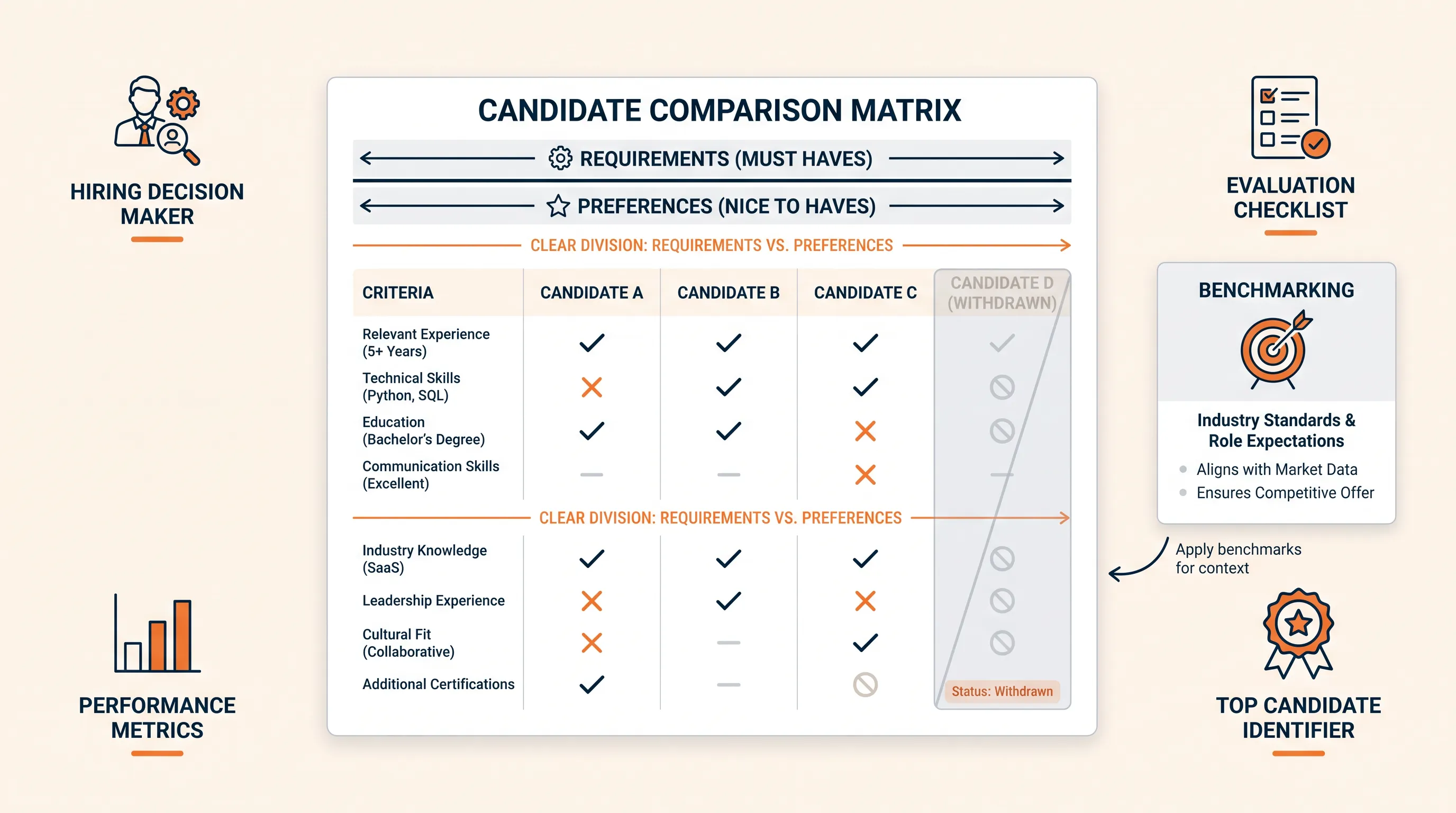
Minimalist infographic featuring a candidate comparison matrix with clear divisions for requirements and preferences, using warm colors.

Go back to the documented evidence. Not to your memory of the interviews, and not to the ranking you carried out of the final debrief, because that ranking was built to answer a question you're no longer asking. You were choosing among four people. Now you're asking whether anyone left clears the bar.

Relative rankings mislead hiring decisions in a way that's well understood. The anchoring research that Amos Tversky and Daniel Kahneman began in 1974 explains why an evaluation formed next to a stronger candidate rarely gets adjusted enough once the comparison disappears. Second place in a candidate comparison matrix is a statement about the field, not a verdict on the role.

Kahneman later described the fix in one line to Behavioral Scientist: "treat options like candidates," which means you break the judgment into dimensions and score each on facts before the summary verdict. That's what the next three checks do.

Candidate comparison matrix

Rebuild the candidate comparison matrix from the original criteria and the original weights, not from a fresh conversation about who felt strongest. Pull in the interview evidence as it was recorded at the time and the reference findings, along with every risk that was left unresolved when the search was still live. The withdrawn candidate's column comes out, but the criteria and the role benchmarking behind them stay exactly as approved.

Do not rescore anyone to produce a convenient successor. Scores that move without new evidence are the clearest sign that the process is now serving the vacancy rather than the job. If a rating changes, the reason should be a new document or a new reference you can point to.

Independent threshold check

Run each remaining finalist against every essential standard on their own merits. Cleared or not cleared, criterion by criterion, with the evidence named. If important requirements remain unsupported, identify those gaps explicitly rather than relying on an overall impression or treating a strong overall showing as evidence that every essential criterion has been met.

Gaps get filled, not discounted. A second reference on a specific gap or a targeted interview against the original role benchmarking will tell you more than another round of general conversation. Structured methods carry the strongest track record among selection tools, with the Sackett and colleagues 2021 re-analysis putting structured interviews at an estimated validity of 0.42 against job performance, ahead of every other procedure they re-estimated. No assessment or interview format predicts performance with certainty, which is the reason evidence gets confirmed rather than assumed.

Bring your next commercialization hire through the system.

If you’re filling a commercial leadership role inside a growth-stage MedTech environment, the strategy call is where we map the role to CarbonCore.

Schedule a Strategy Call →

Avoid replacement cloning

Separate what the role requires from what you liked about the person who left. Those two lists overlap, and the difference is where mandates quietly get rewritten. If the withdrawn finalist had a competitor pedigree nobody asked for during role benchmarking, that pedigree doesn't become an essential requirement because you enjoyed the interview.

Write the comparison down. Every capability now under discussion should trace back to the approved criteria, and anything that traces back only to the withdrawn candidate gets flagged as preference. Preference is allowed to inform hiring decisions at the margin. It isn't allowed to become a standard nobody approved.

Reconfirm candidate interest

Move quickly on contact. Weeks have passed for the people still on your slate, and their circumstances changed while you were finishing with someone else. Confirm availability and motivation by asking directly what has shifted since you last spoke and which other processes they've entered.

Be honest about where the search stands without ranking anyone. You can say the timeline moved and the process is active again. You don't say a spot opened up, and you never frame the conversation in a way that makes someone the fallback. Candidate experience research compiled by JobScore found 33% of North American candidates who withdrew cited having their time disrespected during the process, so the tone of this call has consequences beyond the immediate answer.

Clarity is what keeps people engaged. Jamie Kohn, Senior Director Analyst in the Gartner HR practice, told the firm's newsroom that "setting expectations early and keeping the process clear is critical to preventing candidates from dropping out." Give the remaining finalists a date and a next step, then meet it.

Choose the recovery path

There are two acceptable outcomes and one unacceptable one. Proceed with a finalist who independently meets the approved standard, or reopen outreach. What you don't do is make hiring decisions by proceeding with the strongest remaining name in the candidate comparison matrix on the grounds that they were close.

Reopening is less expensive than it feels, because the groundwork survives. The mandate and the role benchmarking stay, along with the market intelligence the search already produced about who's available and what they cost. Passive outreach is where most of that value sits, since LinkedIn's data puts 70% of the global workforce in the passive category of people who will take a specific call.

Weigh the timeline honestly. SHRM's 2025 benchmarking brief, which drew on more than 2,300 members, found median time-to-fill at roughly a month and a half for executive and nonexecutive roles alike. In a critical commercial leadership hire, an additional search period may be easier to absorb than lowering the standards established for the role.

Audit the process

Now look backward, because the withdrawal told you something. Review how long the process ran and where communication went quiet, then check whether the role as described in interviews matched the role as approved and whether compensation was tested against the market before offers were discussed. Poor communication is the most commonly cited reason candidates abandon processes, at 47% in the same research cited earlier, and it's also the failure most within your control.

Separate what you caused from what you didn't. A competing offer at a higher level or a spouse's relocation sits outside what you caused. An eleven-week timeline with a three-week silence in the middle is a process failure, and so is a scope change introduced after final interviews. Speed matters at the senior end, where one 2026 compilation of hiring benchmarks put the executive average at 120 days against 46 days for entry-level roles.

Then assign the fixes with names and dates attached. Which stage gets cut and who owns candidate updates, along with whether role benchmarking needs a second look before outreach resumes. Feed each of those into the candidate comparison matrix for the next slate so the improvement shows up in hiring decisions rather than in a retrospective document nobody reopens.

Keep standards intact

Vacancy pressure arrives as a reasonable-sounding suggestion to widen one criterion or treat a runner-up as validated because the field has thinned. Each of those is a decision to learn less about someone you're about to trust with a commercial mandate.

TruAlign Partners helps growth-stage MedTech companies define what a commercial hire needs to accomplish before the search begins. Through CarbonCore, those outcomes guide candidate evaluation and help keep the hiring team aligned if the search changes course. If a finalist withdraws, the question remains the same: does another candidate have the evidence to succeed in the role? Schedule a call to discuss your commercial hiring needs.


Bring your next commercialization hire through the system.

If you’re filling a commercial leadership role inside a growth-stage MedTech environment, the strategy call is where we map the role to CarbonCore.

Schedule a Strategy Call →

The decision owner should report the withdrawal, its documented reason, and the recovery path without naming a replacement prematurely. Explain whether the remaining finalists will undergo an independent threshold check or whether outreach will reopen. Give the board a date for the next recommendation, rather than promising a hire before the evidence supports one.

Ask whether their availability, priorities, compensation expectations, or other active processes have changed since the last conversation. Request a clear response by a defined date and confirm any notice-period or location constraints. A finalist who avoids a decision or introduces new conditions needs a fresh assessment before the process continues.

Reopen outreach when no remaining finalist meets every essential requirement, when a critical gap cannot be verified, or when candidate interest has weakened beyond repair. The original mandate, role benchmark, and market notes can guide the new outreach. This preserves the search foundation while preventing a weak match from becoming the default choice.

The client should assign each process fix to one owner with a due date, such as shortening an interview stage or setting a communication interval. Record the changes before outreach resumes, then include them in the next search plan. This turns the withdrawal into a process correction instead of a note filed after the event.

A finalist who misses an essential requirement should not advance unless the requirement itself is formally reviewed and changed before the decision. A gap in a nonessential preference can be acceptable when the business rationale and supporting evidence are documented. The distinction must come from the approved criteria, not vacancy pressure.

Schedule a Strategy Call

Map the role to CarbonCore and confirm fit before search work begins.

Schedule a Strategy Call

You Might Also Like

Discover more insights and articles

A modern glass-walled office meeting room featuring a boardroom table with open folders, a laptop, a tablet, and decorative elements.

How Healthtech Companies Should Compare Executive Search Firms

Growth-stage MedTech companies should compare executive search firms on evidence, especially when hiring critical commercial leaders. Ask each firm for anonymized comparable searches and a documented process from mandate definition through onboarding. Then score every firm against the same weighted criteria tied to the commercial risks of the role you're filling.

A modern office scene featuring a glass conference table surrounded by a diverse hiring team reviewing dossiers in natural lighting.

How to find executives who can lead your next growth stage

This article explains how to find executives for the specific transition your company faces next. It covers defining the move ahead and testing what each candidate personally built.

A modern office meeting room with a diverse group of professionals engaged in discussion around a central table, featuring candidate profiles and milestone m…

How to align managers and decision rights when recruiting a team

This article explains how to assign decision rights across a set of interdependent hires when recruiting a team so managers stop relitigating role scope and sequencing halfway through a search. It covers how to map roles against a business milestone and how to name who decides what at every stage.

A hyper-realistic office scene featuring a large meeting table with stacks of folders, scorecards, sticky notes, and a closed laptop.

Scorecard Criteria for Shortlisting Medical Device Commercial Leadership Search Firms

A useful scorecard weights relevant MedTech placement evidence at 25 points and candidate access and sourcing at 20. Assessment rigor carries 20 points and commercialization fluency 15, with search execution and contract terms at 10 points each. Pass-fail safeguards sit outside the score. A firm that falls short on one of those safeguards should generally receive additional scrutiny and may need to be removed from consideration regardless of its total score.