Reject informal consensus
Consensus feels collaborative and behaves like a veto pool. Nobody says no, so nobody owns the delay, and the search drifts while a manager who was never named as an approver keeps asking for one more conversation. Trent Cotton, head of talent acquisition insights at iCIMS, put the market consequence plainly: "Frustrated candidates drop off fast, so the firms that cut red tape and move top talent through quickly will own the market."
There's a second cost, which is that consensus invites reopened criteria. A manager who disagreed with the mandate in week one and stayed quiet gets a second shot at it in week eight, dressed up as a concern about a finalist. By then the delay cascades into every dependent search in the sequence.
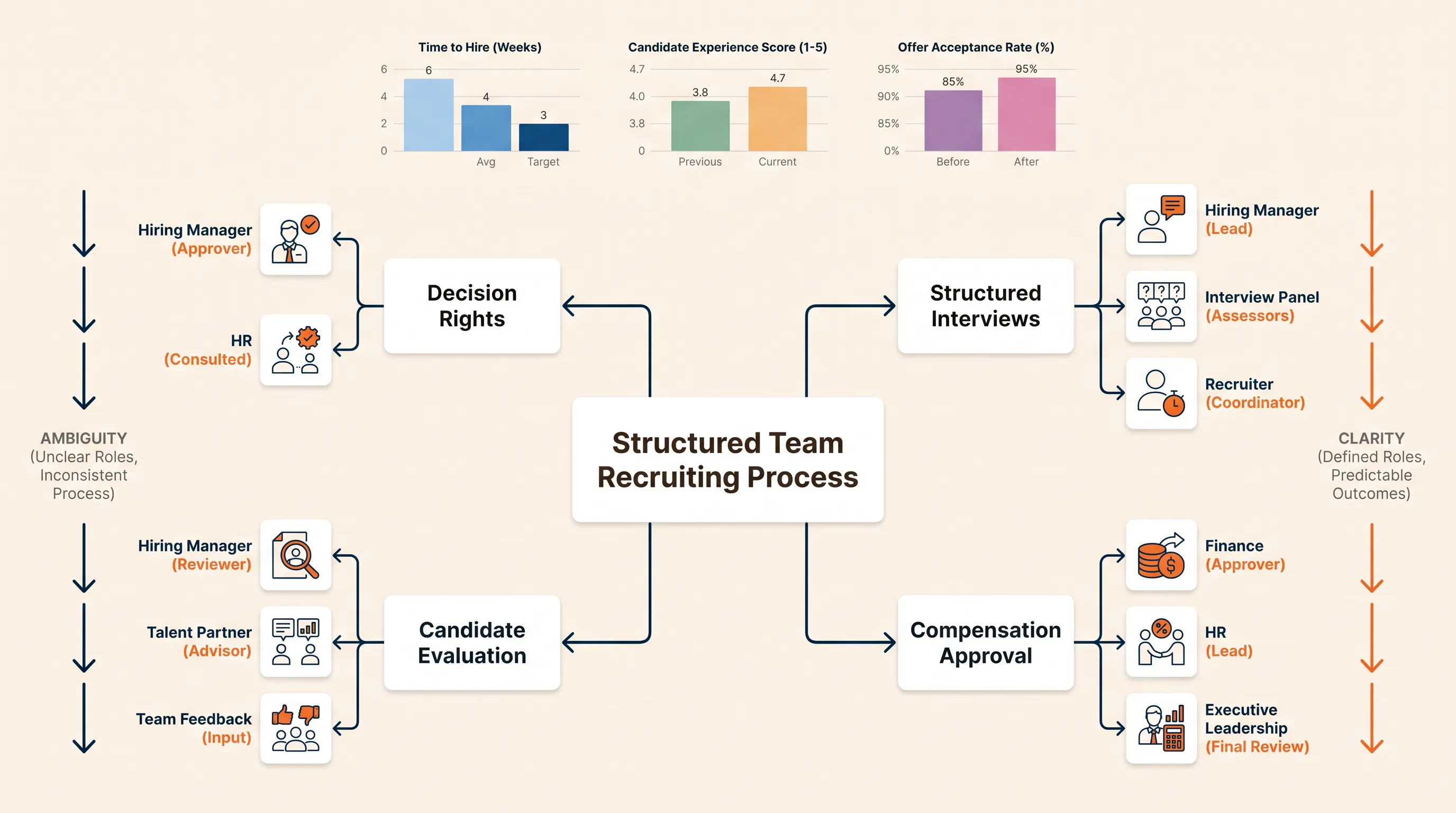
Use one test. Your recruiter should be able to answer two questions from a candidate at any point without checking: who makes this decision, and by what date. If the answer requires a meeting, the candidate comparison process isn't defined yet, and recruiting a team under those conditions means paying for the ambiguity in withdrawn finalists.
Govern recruiting a team
Decision rights written once and stored in someone's inbox decay within a month. They need a live record that covers all roles at the same time, because the conflicts that matter are cross-role: two managers chasing the same candidate profile and two requisitions drawing on one approved budget line.
TruAlign Partners is an executive search firm focused on commercialization hiring for growth-stage MedTech and life sciences companies. Each search starts by defining what the hire needs to accomplish, then translating those outcomes into role competencies, structured interview questions, and scorecards. TruAlign also uses the McQuaig Job Survey to establish a behavioral benchmark for the role, with candidate assessments providing another point of evidence. Through the CarbonCore platform, shortlisted candidates, assessment findings, and interview feedback are organized against the same criteria so the hiring group can compare evidence consistently.
For a multi-role search, that creates one commercial hiring plan with a documented decision process attached. Competing requests surface as explicit trade-offs rather than surprises at the offer stage, while each role is evaluated against defined outcomes, competencies, and evidence that the hiring team can review consistently.
Reassess with market evidence
Holding the commercial hiring plan isn't the same as refusing to change it. Changing it informally, in a hallway, without updating the record, is the failure mode worth guarding against. So define in advance what counts as evidence strong enough to reopen a settled decision.
Four triggers justify a documented reassessment:
-
The profile is scarce in the market after a defined search period, confirmed by sourcing data rather than impression
-
Compensation expectations from qualified finalists sit consistently above the approved band
-
The candidate comparison process produces weak finalists across two full slates
-
The business milestone itself moves, which changes what the role was built to deliver
The leadership roles carry the most exposure here. Pave's analysis of 14,000 executives put VP of Sales tenure at 2.0 years and CRO tenure at 1.8 years, and research from the University of South Carolina's Center for Executive Succession found roughly 40% of external executive hires fail within 18 months. Pushing a mismatched profile through because the plan said so is more expensive than redesigning the role.
When a trigger fires, run the reassessment the same way you ran the original decision. The mandate owner revises scope and level, and the sequence gets re-cut against the milestone. Keep any criteria the evidence didn't touch. Reassessment is a narrow correction.
What this buys you
Clear decision rights make disagreement productive, because an argument about scope happens before sourcing instead of at the offer, and the person who settles it is known to everyone in the room. That's the difference between a plan that holds and four searches drifting apart.
TruAlign Partners builds this structure into commercialization searches for growth-stage MedTech and life sciences companies by defining what each hire needs to accomplish, clarifying decision ownership, and translating those outcomes into competencies, interview questions, scorecards, and behavioral assessment before the first candidate conversation. If you're coordinating several interdependent hires and your managers disagree on scope or sequence, schedule a call with TruAlign Partners to create one documented hiring plan and a consistent framework for evaluating candidates.