How to find executives who can lead your next growth stage

This article explains how to find executives for the specific transition your company faces next. It covers defining the move ahead and testing what each candidate personally built.

This article explains how to find executives for the specific transition your company faces next. It covers defining the move ahead and testing what each candidate personally built.
Most searches to find executives start with a target company list and a title. Too often, the search ends with someone who ran a function that was already working when they arrived. That person inherited a staffed team and a system somebody else designed, and the hiring team reads that as proof they can build one.
Around half of leadership transitions fail, according to research published in Harvard Business Review by Mark Byford and Michael Watkins. Stage mismatch can be one contributing factor. The leader who thrives at 800 people with a mature operating cadence is solving a different problem than the leader who has to invent that cadence from nothing.
So the question worth asking is narrower. Who has crossed the exact transition you are about to cross, and what did they personally build while crossing it?
Name the move in one sentence that a candidate could repeat back to you. Reaching repeatable revenue after founder-led selling. Going from one market to four. Replacing heroics with a managed organization that runs without the founder in every room.
Your current growth stage constrains how you find executives far more than your eventual scale does. Reid Hoffman described distinct stages of scaling in Harvard Business Review, and each one demands a different kind of leader, because the bottleneck changes. At 30 people the bottleneck is the founder's attention. At 300 it's the absence of structure that was never needed before.
Write down what breaks first if nothing changes. That failure point should sit at the center of the mandate. Other responsibilities still matter, but they should be evaluated in relation to that primary challenge.
Turn the transition into things that will exist twelve months from now that don't exist today. A forecasting process accurate within 15 percent. A sales team of nine with two managers who were hired and trained by this leader. A pricing model that holds across two new markets.
Then write the constraints next to each outcome, honestly, because this is where candidates self-select. Budget. Headcount. The state of your data. How much of your own time you'll give, and how much you'll take back. For executives who are genuinely suited to the stage, clear constraints can make the opportunity more credible rather than less attractive, because they show what the building challenge actually looks like.
A useful first-year outcome has four parts:
The system, team, or capability that must exist by month twelve
The measurable result it produces
The resources available to build it, stated as a real number
What the executive owns outright versus what they share with you
Keep the list to four or five outcomes. More than that and you've written a wish.
Now convert those outcomes into a candidate profile that describes building experience rather than pedigree. Gallup has found that organizations often struggle to select people with the right talent for management roles, and in senior hiring that makes it especially important to build candidate profiles around demonstrated capabilities rather than logos and titles. Claudio Fernández-Aráoz of Egon Zehnder argued in his 2014 study of talent spotting that in volatile environments the better predictor is potential and adaptability.
Working style belongs in the profile too. Someone who needs a chief of staff and a planning cycle to produce a decision is wrong for a company that has none of those. Ben Horowitz drew the distinction sharply when he wrote that "Peacetime CEO works to minimize conflict. Wartime CEO heightens the contradictions." The same split runs through every function below the chief executive.
If you’re filling a commercial leadership role inside a growth-stage MedTech environment, the strategy call is where we map the role to CarbonCore.
Schedule a Strategy Call →Good executive hiring criteria describe evidence. "Hired and promoted at least two managers inside a team they grew from 5 to 25 during a market expansion" is a criterion, because a candidate either has that history or doesn't.
Build your executive hiring criteria around four kinds of proof:
Systems they designed from scratch, including the version that failed first
People they hired, developed, and promoted, with names and current roles
Tradeoffs they made when two priorities couldn't both be funded
Resources they controlled, stated as budget and headcount they signed for
Steven Kaplan and his coauthors assessed 316 CEO candidates and found execution-related abilities such as persistence and efficiency tracked more closely with success than interpersonal ones did. That finding should shape what you weigh, though no single criterion or assessment predicts how a particular person will perform in your company.
A title at a famous company tells you the company was successful without identifying the person as the cause. Ask when they joined relative to the growth curve, and you'll discover they arrived two years after the systems were built and spent their tenure maintaining them well.
Experience at your target scale is the most seductive wrong signal. A VP who currently runs a 200-person organization at a company doing $400 million may not have recently hired a first sales rep or built a compensation plan from scratch. Treat prior scale as context, not as qualification, and keep your executive hiring criteria pointed at the transition itself.
Many of the leaders who have crossed your transition are not actively applying for new roles. LinkedIn's talent research puts the share of the global workforce open to opportunities but not actively searching at roughly 70% passive talent, which means the best-matched person for your stage will not appear in your applicant pool.
Three sourcing methods work together here to find executives, and substituting one for another leaves gaps. Mapping finds the names. Outreach makes contact credible. Referrals tell you what the name actually did.
Executive talent mapping starts with companies. List 20 to 40 organizations that completed the move you're about to make, and pin down the window when they made it, a two-year stretch you can date from funding announcements or product launches.
Then identify who held relevant responsibility before and during that window. This is the discipline that makes executive talent mapping different from pulling a list off a database, because timing is the whole signal. A head of operations hired in month 30 of a transition that started in month 1 inherited the thing you need someone to build.
Write to the specific person about the specific problem. Name the transition and the mandate, and the message stops reading like a recruiter blast. Proven builders decide fast when they can see the shape of the work, and they decline fast when they can't, which saves everyone a month.
What belongs in the first message is short: the move you're making and one sentence on why their particular history fits. Leave out the adjectives about culture. Your mapping work has already told you why this person, so say it plainly.
If you’re filling a commercial leadership role inside a growth-stage MedTech environment, the strategy call is where we map the role to CarbonCore.
Schedule a Strategy Call →Board members and operators who have run the same transition know who did the building, because they watched it happen. When a referral comes in, ask one question before anything else: what did this person build themselves, and what did they inherit? Vague praise means proximity rather than ownership.
TruAlign Partners works with growth-stage MedTech companies on this part of the search, helping leadership teams identify executives who have actually built through a comparable transition. The process reaches beyond the active applicant pool and distinguishes operators who created a system from those who primarily inherited and scaled one. Combine that reach with your own executive talent mapping and the candidate set changes shape. You end up with fewer names and far better ones.

Evidence beats narrative. Senior candidates are often skilled at presenting a coherent career narrative, but that narrative may not make individual ownership clear. Structured follow-up questions help separate what the candidate personally built from what the broader team delivered. Use more than one method, and make the methods job-related, which is also what the U.S. Equal Employment Opportunity Commission's guidance on selection procedures expects of any assessment used in hiring.
Walk each role in order, from the start of their career forward. The approach comes from the chronological interviewing method developed by Brad Smart, and the value is cumulative, because patterns appear across roles that no single role reveals.
For every position, establish what they inherited and what changed as a result. When a candidate shifts into "we" for a stretch of the story, slow down and ask what their piece was. That shift is a useful signal to probe more closely.
Give them your actual first-year problem with the actual constraints, and ask for a plan. Not a strategy deck. What they'd do in the first 90 days and what they'd do if the budget came in at half.
Watch for sequencing and for comfort with missing infrastructure. A candidate who struggles to adapt after learning that supporting infrastructure does not yet exist may be showing a mismatch with the stage. Google's own structured interviewing research supports giving every candidate the same scenario and the same rubric, since comparison is impossible otherwise.
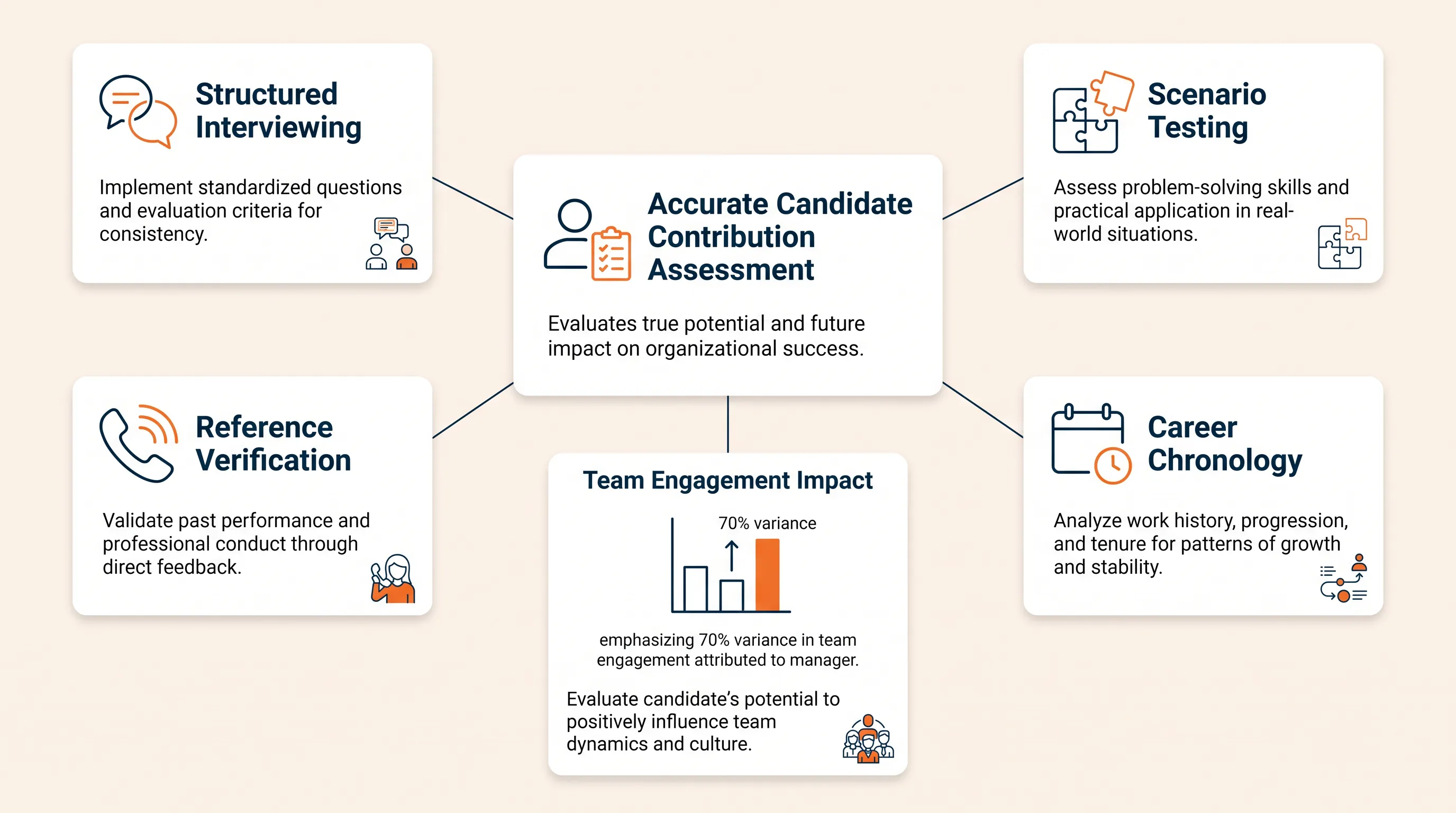
Speak with people who were in the room during the transition: a former manager and someone who reported to them directly. The direct report conversation is the one most searches skip when they find executives and the one that tells you how the team was actually run. Gallup's research attributes 70% of the variance in team engagement to the manager alone, so how this person led under pressure matters as much as what they shipped.
Ask each witness to describe one decision the candidate made when resources were short. Ask what the candidate got wrong. References that contain no failures are references that weren't close enough to see any.
Score every finalist against the same first-year outcomes and the same executive hiring criteria as you use the evidence you collected. CB Insights' analysis of startup post-mortems lists not having the right team among the leading reasons companies fail, and inconsistent comparison is how the wrong team gets assembled one defensible decision at a time.
Put the candidates side by side on a single page: outcome by outcome, evidence by evidence, with gaps marked as gaps. The person whose record maps onto your transition will rarely be the person with the most recognizable résumé, and that's the point. Your executive talent mapping identified who crossed this bridge before, and the scoring is where you stop negotiating with yourself.
Bench strength for leadership roles remains thin across industries, as DDI's Global Leadership Forecast has documented year after year. That scarcity is an argument for precision.
When you find executives, pick the leader prepared to build what comes next. The résumé that impresses your board is worth less than the evidence that this person has already done the specific, unglamorous construction work your next twelve months require, under similar constraints, with their own hands.
TruAlign Partners helps growth-stage MedTech companies define stage-fit criteria, translate first-year outcomes into structured evaluation criteria, and test what each candidate personally built. If you're preparing for a growth transition and need to find executives who have crossed it before, schedule a call with our team.

If you’re filling a commercial leadership role inside a growth-stage MedTech environment, the strategy call is where we map the role to CarbonCore.
Schedule a Strategy Call →Verify ownership by reconstructing the candidate’s role during each major change. Ask what existed before they arrived, what decisions they made, which resources they controlled, and what remained after they left. Confirm those details with a former manager and direct report. Consistent answers provide stronger evidence than a polished career summary.
Yes, if you assess the work rather than the employer’s size. Ask whether the candidate built systems, hired early employees, or made resource decisions under constraints similar to yours. A leader from a larger company can fit a smaller stage when their personal record includes creation rather than management of established operations.
Keep the first message specific and brief. State the transition, the first-year mandate, and the part of the person’s history that matches it. Include enough context for an informed response, but leave out generic culture language and broad claims about the company. Passive candidates need a clear problem to evaluate.
Contact references after the candidate has completed structured interviews and a realistic growth scenario, but before making an offer. Speak with a former manager and a direct report who witnessed the relevant transition. Ask about one resource-constrained decision, one mistake, and the candidate’s effect on the team.
Yes. Use the same first-year outcomes, stage-fit criteria, interview questions, and scoring definitions for every finalist. This makes gaps visible and reduces the effect of résumé prestige or interviewer preference. The structure helps you find executives whose evidence matches the transition. TruAlign Partners can schedule a call to review your search.
Map the role to CarbonCore and confirm fit before search work begins.
Schedule a Strategy Call
This article sets out a recovery protocol for the moment your preferred finalist pulls out of a senior search. It covers how to document the withdrawal and rebuild the evidence you already gathered so you can decide whether anyone left on the slate clears the approved standard on their own.

This article explains how to gather comparable evidence about how a finalist actually decides things through scenario simulations and disciplined reference work. It covers what to build and how to score it before naming the signals that mislead the people watching.

This article compares seven of the best executive search firms across different leadership needs, from large public-company succession work to founder transitions and growth-stage hiring. It also explains how to evaluate a search partner based on the outcomes a critical hire needs to achieve, the expertise required to deliver them, and the assessment process used before you sign a retainer.

Validating a search firm shortlist means demanding four kinds of proof. Those proofs are comparable placements in your function and market segment and verifiable access to passive candidates, together with a documented process with named senior owners and a structured assessment method. Score each firm against the same criteria and ask every reference identical questions before you sign.