Which criteria should be mandatory?
Six requirements belong outside the point total as pass-fail gates: directly relevant partner-level experience and a defensible assessment method, together with proactive sourcing beyond databases and written confidentiality controls. Full conflict and off-limits disclosure, along with replacement terms you can live with, make up the rest. A firm that falls short on one of these requirements may warrant removal from consideration regardless of its overall score.
The industry's own standard supports this. The AESC Client Bill of Rights requires that off-limits and guarantees be written terms of the engagement, along with conflicts and data management, which makes a verbal assurance on any of them a departure from the profession's baseline.
A gate structure also protects you from your own scoring. Weighted totals reward breadth, so a firm with polished materials and a strong brand accumulates points across six categories and absorbs one critical failure without ever dropping to second place. Separating the gates stops that arithmetic. Decide the gates before the pitches and tell each firm what they are.
What evidence should finalists provide?
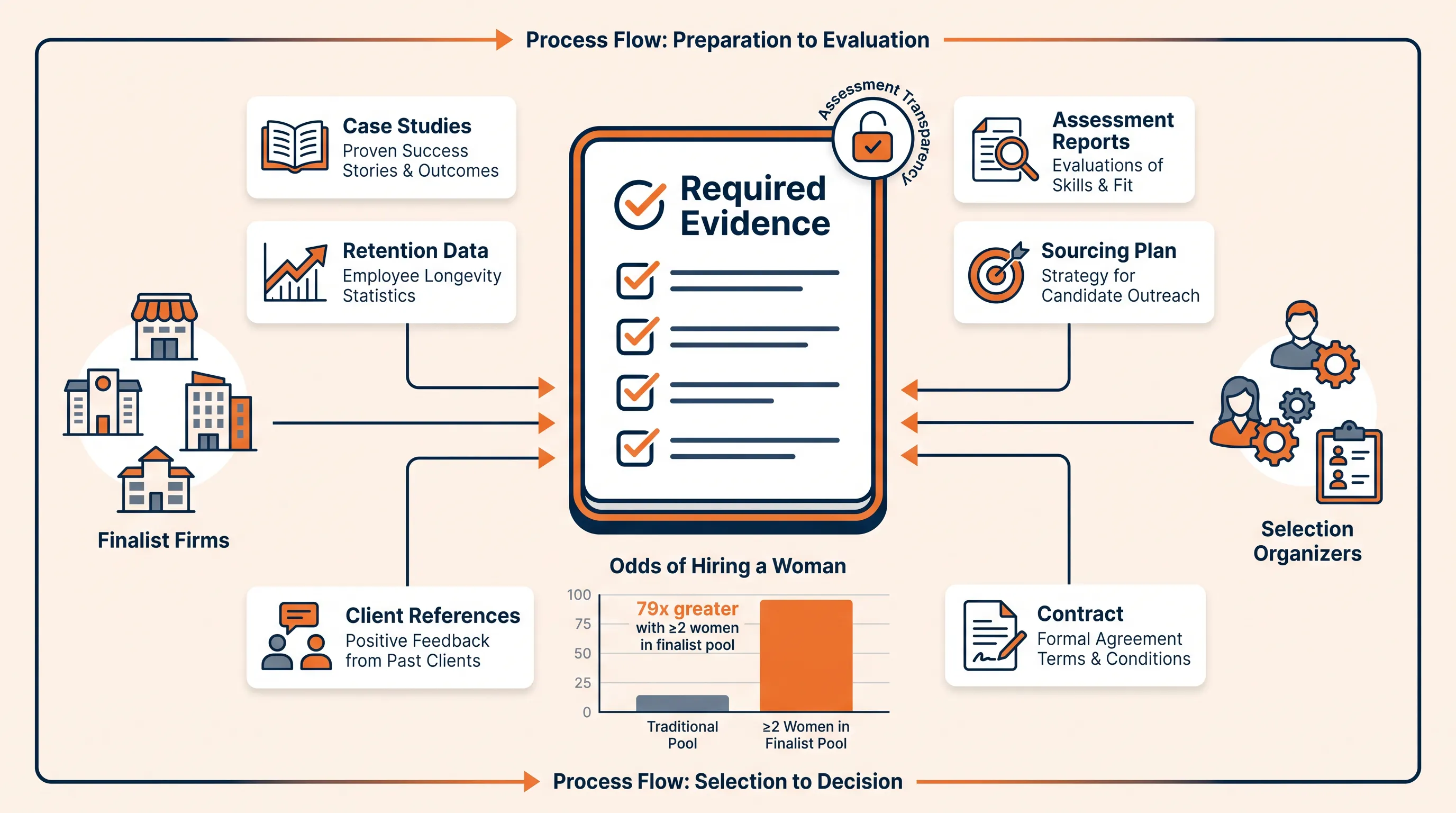
Require documents, not assertions. Every claim a firm makes in a pitch comes with something you can read or check. Build the evidence request into the invitation so all finalists are preparing against the same list.
One item deserves particular care. Stefanie Johnson and David Hekman of the Leeds School of Business published research in Harvard Business Review that found the odds of hiring a woman were 79 times greater when at least two women were in the finalist pool. The practical reading is that how broadly a firm searches, and whether it tracks that reach, shapes the slate you end up choosing from.
Ask every finalist for:
-
Three comparable placement case studies with the business problem, the slate, and the outcome
-
Twelve and twenty-four month retention data across their MedTech commercial placements
-
Two client references from searches that were difficult, plus one from a search that failed
-
A redacted candidate assessment report and the interview guide behind it
-
A written sourcing plan with named target organizations
-
The complete contract, including schedules and exclusions
Documents that arrive late or incomplete are themselves a data point.
Which red flags should lower scores?
Treat vagueness as information. A firm that can't name the device category or the revenue stage behind a placement is describing work it either didn't lead or doesn't remember, and both readings cost points.
Database dependence is the red flag that masquerades as capability. LinkedIn's talent research finds that 70% of the global workforce is passive. Commercial leaders delivering strong numbers in MedTech sit squarely in that majority, which means a sourcing model built on who's already in a system is fishing in the smaller pond and calling it a reach.
Watch for these:
-
Legacy credentials, where the relevant placements are five or more years old
-
Guaranteed speed, offered before the role has been scoped
-
Unstructured interviews presented as "partner judgment"
-
Diversity commitments with no tracking method attached
-
Pitch partners who disappear after signing, replaced by associates
-
Confidentiality handled informally, with no written data protocol
-
Fee language that leaves expenses or replacement triggers open-ended
Several of these red flags together may indicate that a firm's sourcing reach or search process is less current than its positioning suggests.
How should stakeholders score finalists?
Lock the weights before the first pitch and score independently. The sequence matters more than the rubric. Once a group discusses a presentation out loud, the first confident voice sets the anchor and the rest of the scoring becomes commentary on that anchor.
Google's internal analysis, reported by Laszlo Bock in Work Rules!, found that four interviewers reach roughly 86% predictive reliability on a candidate decision, with additional interviewers adding little. Four to six evaluators scoring a search firm independently gives you the same return without turning the process into a committee.
The reconciliation step is where the real work happens, and most teams skip it. A three-point gap between the CEO and the commercial lead on assessment rigor means they heard different things, and that disagreement is worth more than the final number. Use anchored ratings with written evidence required for any score above three or below three. And resist the pull to adjust weights after a polished presentation, because that's scoring the pitch rather than the partner.
How can TruAlign structure the comparison?
Bring the scorecard to the conversation and use it as the agenda. TruAlign Partners is a MedTech search firm focused on small and mid-sized medical device companies hiring commercial leadership for growth-stage roles, and every search is led personally by founder Michelle Bohannon.
The firm's CarbonCore methodology starts by defining what the hire needs to accomplish before sourcing begins, then translating those outcomes into role competencies, structured interview questions, and scorecards. TruAlign also uses the McQuaig Job Survey to establish a behavioral benchmark for the role, with candidate assessments adding another point of evidence alongside the structured evaluation process.
Everything lands in one place. Shortlisted profiles and assessment findings sit in CarbonCore with interview feedback and supporting documentation so your stakeholders score the same evidence. Schedule a strategy call and walk through your scorecard criteria.
Schedule a strategy call.